
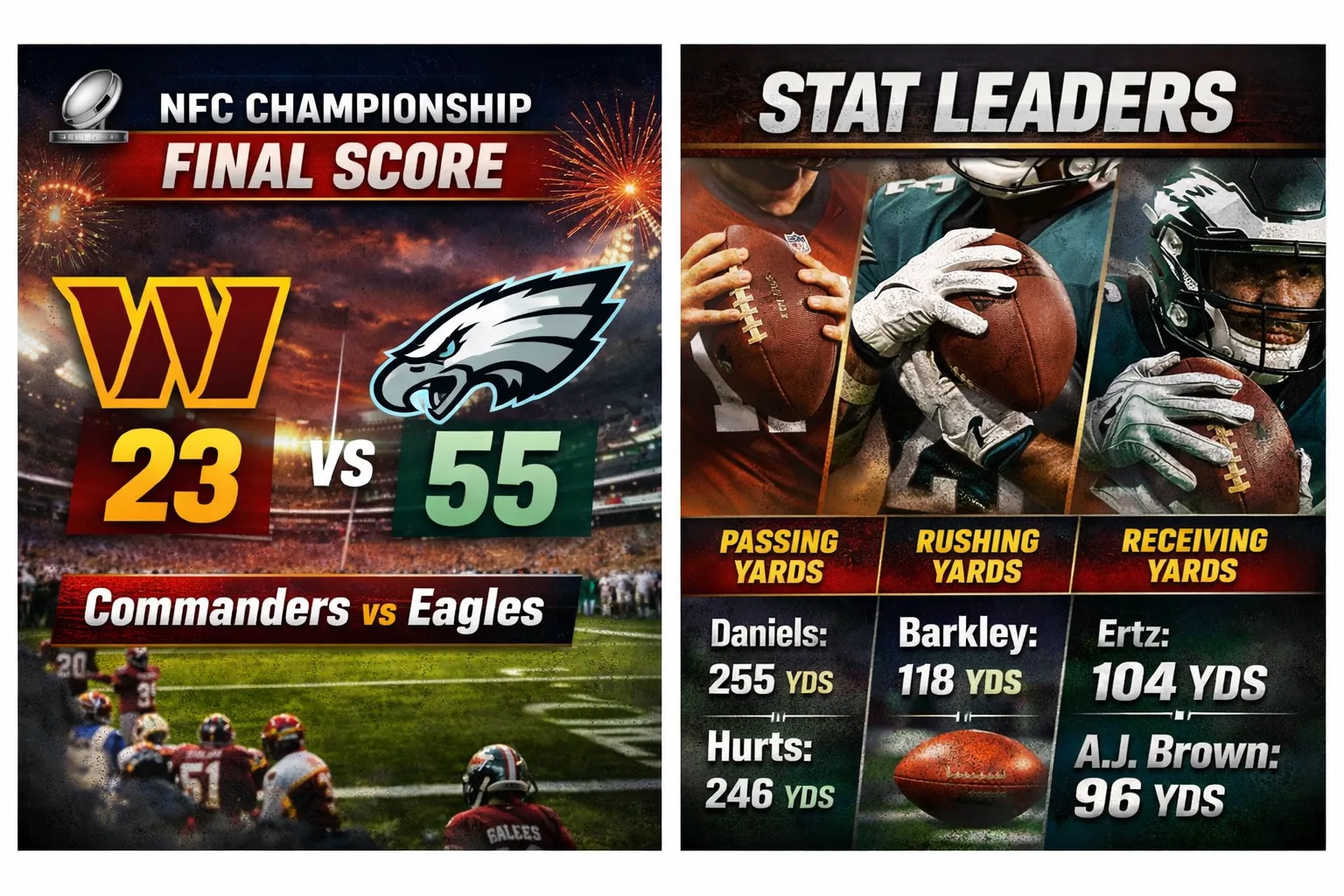
The NFC Championship game between the Washington Commanders and the Philadelphia Eagles at Lincoln Financial Field delivered a powerful statement from Philadelphia, as they surged to a commanding 55–23 victory in front of 69,879 fans.
With a Super Bowl berth on the line, the Eagles showcased elite execution, explosive rushing, and ruthless red zone efficiency, while Washington struggled to overcome turnovers and defensive breakdowns.
Philadelphia entered the game with a 14–3 record and an imposing 8–1 home mark, and they played with the authority of a team fully in control of its destiny.
| Category | Washington Commanders | Philadelphia Eagles |
|---|---|---|
| Final Score | 23 | 55 |
| Total Yards | 350 | 459 |
| Total Plays | 77 | 66 |
| Yards Per Play | 4.5 | 7.0 |
| Turnovers | 4 | 0 |
| Possession Time | 29:29 | 30:31 |
| First Downs | 22 | 28 |
| Red Zone | 1/2 | 7/7 |
| Third Down | 7/17 | 5/10 |
| Fourth Down | 4/6 | 1/1 |
| Penalties | 9 for 47 yards | 5 for 30 yards |
Washington, finishing 12–5 and 5–3 on the road, displayed resilience and moments of promise, particularly through rookie quarterback Jayden Daniels, but the gap in efficiency ultimately defined the outcome.
The final score reflected the contrast in discipline, ball security, and physical dominance that Philadelphia imposed across all four quarters.
The Eagles outgained Washington 459 yards to 350, averaged 7.0 yards per play, and committed zero turnovers, while the Commanders gave the ball away four times.
That difference alone shaped the entire flow of the contest.
Key themes that emerged from the opening minutes
- Philadelphia controlled the line of scrimmage
- Washington struggled to finish drives
- Turnovers consistently shifted momentum
- Red zone efficiency separated the teams
The scoring began with Washington showing early promise.
Zane Gonzalez opened the game with a 34-yard field goal after an 18-play, 54-yard drive that consumed over seven minutes.
It was a strong statement that Washington intended to compete physically and control possession.
That optimism was short-lived.
On the very next play from scrimmage, Saquon Barkley exploded through the Commanders’ defense for a stunning 60-yard touchdown run.
In just 18 seconds, Philadelphia flipped the game’s emotional energy.
Barkley struck again later in the quarter with a four-yard rushing touchdown, and suddenly the Eagles had seized complete control.
The first quarter ended with Philadelphia leading 14–3, and their dominance was already evident.
Philadelphia continued pressing in the second quarter.
Washington responded with a 46-yard Gonzalez field goal, trimming the margin to 14–6, before Jayden Daniels delivered one of his best throws of the night.
Washington Commanders Vs Philadelphia Eagles – Key Match Player Stats
| Passing Leaders | Stats |
|---|---|
| Jayden Daniels (WSH) | 29/48, 255 YDS, 1 TD, 1 INT |
| Jalen Hurts (PHI) | 20/28, 246 YDS, 1 TD |
| Rushing Leaders | Stats |
|---|---|
| Jayden Daniels (WSH) | 6 CAR, 48 YDS, 1 TD |
| Saquon Barkley (PHI) | 15 CAR, 118 YDS, 3 TD |
| Receiving Leaders | Stats |
|---|---|
| Zach Ertz (WSH) | 11 REC, 104 YDS |
| A.J. Brown (PHI) | 6 REC, 96 YDS, 1 TD |
| Defensive Leaders | Washington | Philadelphia |
|---|---|---|
| Tackles Leader | Bobby Wagner – 9 (5 solo) | Zack Baun – 12 (8 solo) |
| Sack Leader | Frankie Luvu – 1 | Oren Burks – 1 |
Daniels connected with Terry McLaurin on a 36-yard touchdown pass that brought the Commanders within two points, though the two-point conversion failed.
Philadelphia answered with authority.
Jalen Hurts punched in a one-yard rushing touchdown following a 12-play, 72-yard drive that consumed more than five minutes.
Just over a minute later, Hurts found A.J. Brown on a four-yard touchdown pass, pushing the lead to 27–12.
Washington added one final field goal before halftime, but Philadelphia still entered the break ahead 27–15.
Halftime indicators of control
- Eagles had scored on five of six drives
- Barkley already had two rushing touchdowns
- Hurts was flawless in ball security
- Washington had relied heavily on field goals
Philadelphia opened the third quarter by continuing its relentless pace.
Hurts scored on a nine-yard rushing touchdown, extending the lead to 34–15.
Washington briefly found life when Daniels rushed for a 10-yard touchdown and completed a two-point conversion pass to Olamide Zaccheaus, narrowing the gap to 34–23.
It was the closest Washington would come for the rest of the game.

From that point forward, Philadelphia slammed the door shut.
Hurts scored another one-yard rushing touchdown early in the fourth quarter.
Barkley followed with his third rushing touchdown on a four-yard run.
Finally, rookie Will Shipley added a two-yard rushing score to complete the avalanche.
The Eagles posted 21 unanswered points in the final quarter, transforming a competitive contest into a decisive rout.
Fourth quarter domination highlights
- Three rushing touchdowns
- One 80-yard scoring drive
- Washington shut out
- Crowd atmosphere fully in control
The quarterback comparison defined the difference in efficiency.
Jayden Daniels finished 29 of 48 for 255 yards, one passing touchdown, and one interception.
He added 48 rushing yards on six carries and a rushing touchdown.
Daniels showed courage, athleticism, and leadership, but he was forced into high-risk situations due to the scoreboard and frequent defensive pressure.
His yards-per-pass figure and turnover exposure reflected how difficult the night became.
Jalen Hurts, on the other hand, was ruthlessly efficient.
He completed 20 of 28 passes for 246 yards and one passing touchdown.
More importantly, he rushed for three touchdowns and avoided any turnovers.
Hurts consistently punished Washington’s defensive schemes near the goal line, displaying elite decision-making and physical toughness.
Quarterback performance snapshot
- Daniels: 255 passing yards, 2 total touchdowns, 1 interception
- Hurts: 246 passing yards, 4 total touchdowns, 0 turnovers
- Hurts led all players in total touchdowns
- Daniels led Washington in both passing and rushing yards
The rushing game was where Philadelphia completely separated itself.
Saquon Barkley delivered one of the most impactful performances of the postseason.
He rushed 15 times for 118 yards and three touchdowns, averaging nearly eight yards per carry.
His early 60-yard touchdown shattered Washington’s defensive confidence, and his short-yardage power runs sealed the game late.
Philadelphia rushed 36 times for 229 yards and averaged 6.4 yards per attempt.
Washington rushed only 25 times for 99 yards, averaging four yards per carry.
Daniels accounted for nearly half of that production.
The Commanders never established consistent ground control, which allowed Philadelphia to dictate tempo and field position.
Rushing attack contrast
- Eagles: 229 yards, 36 carries, 6.4 yards per rush
- Commanders: 99 yards, 25 carries, 4.0 yards per rush
- Barkley: 118 yards, 3 touchdowns
- Daniels: team-leading 48 rushing yards
The receiving performances told a story of volume versus efficiency.
Zach Ertz led Washington with 11 receptions for 104 yards, acting as Daniels’ primary safety valve.
Terry McLaurin delivered the team’s lone receiving touchdown and remained Washington’s most dangerous deep threat.
The Commanders relied on shorter routes and checkdowns to sustain drives, but struggled to finish possessions.
Philadelphia, meanwhile, leaned heavily on the ground game and used the passing attack for high-impact plays.
A.J. Brown led the Eagles with six receptions for 96 yards and a touchdown.
His physicality after the catch consistently broke tackles and extended drives.
Receiving leaders summary
- Ertz: 11 catches, 104 yards
- Brown: 6 catches, 96 yards, 1 touchdown
- McLaurin: 36-yard receiving touchdown
- Eagles relied more on rushing dominance than passing volume
Red zone efficiency was arguably the most decisive factor of the entire game.
Philadelphia was perfect, scoring touchdowns on all seven red zone possessions.
Washington reached the red zone only twice and scored just once.
This difference alone accounted for a massive swing in total points.
Third down and fourth down efficiency showed Washington fighting to stay alive, but without results.
Washington converted 7 of 17 third downs and 4 of 6 fourth downs.
Philadelphia converted 5 of 10 third downs and 1 of 1 on fourth down.
The Eagles simply did not need to take risks because their scoring efficiency was flawless.
Situational efficiency breakdown
- Eagles: 7-for-7 in the red zone
- Commanders: 1-for-2 in the red zone
- Washington attempted six fourth downs out of necessity
- Philadelphia maintained patience and control
Turnovers destroyed Washington’s chance of staying competitive.
The Commanders committed four turnovers, including three lost fumbles and one interception.
Philadelphia committed none.
Each turnover removed potential scoring opportunities and handed Philadelphia short fields or momentum-shifting possessions.
Discipline also favored the Eagles.
Washington committed nine penalties for 47 yards.
Philadelphia committed five penalties for 30 yards.
That difference repeatedly stalled Washington drives and extended Philadelphia possessions.
Turnover and discipline impact
- Washington: 4 turnovers, 9 penalties
- Philadelphia: 0 turnovers, 5 penalties
- Eagles capitalized on mistakes
- Commanders could not recover from them
Defensively, Bobby Wagner led Washington with nine tackles, five solo, showing his veteran leadership despite the pressure.
Frankie Luvu recorded Washington’s only sack of the game.
For Philadelphia, Zack Baun posted a game-high 12 tackles with eight solo stops, while Oren Burks added a sack.
Philadelphia’s defense was not flashy statistically, but it was disciplined, physical, and opportunistic.
Defensive leaders overview
- Wagner: 9 total tackles
- Baun: 12 total tackles
- Luvu and Burks: 1 sack each
- Eagles forced four turnovers
The final statistics underlined how complete Philadelphia’s performance was.
They ran fewer total plays than Washington, yet gained far more yardage and scored far more efficiently.
They won the rushing battle, the turnover battle, the red zone battle, and the discipline battle.
Washington showed heart, effort, and flashes of future promise, especially through Jayden Daniels, but the NFC Championship spotlight exposed the gap in execution and experience.
Philadelphia walked off their home field having delivered one of the most dominant conference championship performances in recent NFL history, driven by Saquon Barkley’s explosive running, Jalen Hurts’ flawless decision-making, and an offense that simply could not be stopped once it crossed midfield.
About the Author
