
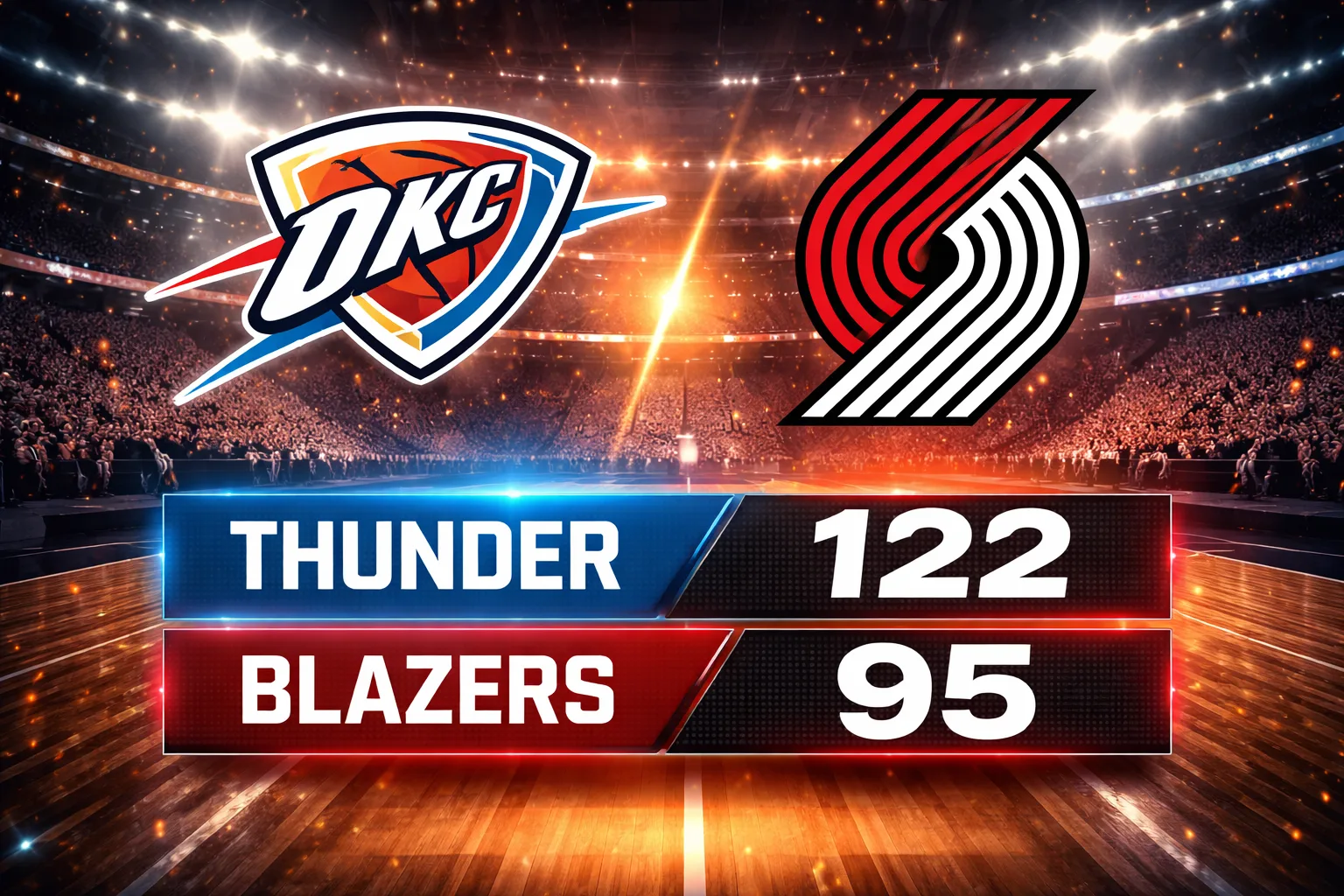
The Oklahoma City Thunder delivered one of their most dominant performances of the season with a commanding 122-95 victory over the Portland Trail Blazers at the Paycom Center.
The win pushed Oklahoma City to an NBA-best 17-1 record while extending their perfect home start to 8-0.
Portland fell to 7-10 overall and 4-6 on the road after struggling to contain Oklahoma City’s pace and efficiency.
Shai Gilgeous-Alexander headlined the performance with 37 points in just three quarters.
The Thunder avenged their only loss of the season, which had come against Portland earlier in November.
From the opening tip, Oklahoma City looked sharper, faster, and far more composed.
The final margin of 27 points reflected how one-sided the contest became.
Oklahoma City shot 53% from the field compared to Portland’s 37%.
They also dominated from three-point range, hitting 42% of their attempts while Portland managed only 26%.
Ball movement was a defining factor as the Thunder recorded 33 assists on 45 made field goals, dominating the match stats.
This was a complete team performance built around elite shot-making, defensive pressure, and disciplined execution.
| Category | Portland Trail Blazers | Oklahoma City Thunder |
|---|---|---|
| Rebounds | 45 | 49 |
| Offensive Rebounds | 16 | 12 |
| Defensive Rebounds | 29 | 37 |
| Assists | 18 | 33 |
| Steals | 8 | 9 |
| Blocks | 4 | 8 |
| Turnovers | 17 | 14 |
| Points Off Turnovers | 28 | 11 |
| Fast Break Points | 13 | 11 |
| Points In The Paint | 40 | 58 |
| Fouls | 19 | 23 |
| Technical Fouls | 0 | 1 |
| Flagrant Fouls | 1 | 0 |
| Largest Lead | 4 | 36 |
Shai Gilgeous-Alexander Delivers MVP-Level Performance
Shai Gilgeous-Alexander was unstoppable throughout the night.
He finished with 37 points on 13-of-18 shooting from the field and a perfect 9-of-9 from the free-throw line.
His efficiency highlighted his ability to control the game without forcing shots.
Gilgeous-Alexander also added seven assists and committed only one turnover in 30 minutes of action.
He consistently broke down Portland’s defense with his first step and footwork in the paint.
His shot selection remained elite, mixing drives, floaters, and mid-range jumpers.
By halftime, he had already scored 28 points.
The game was effectively decided before the fourth quarter even began.
Performance highlights
- 37 total points
- 13 made field goals on 18 attempts
- 9-of-9 at the free-throw line
- 7 assists
- Only 1 turnover
Thunder’s First Quarter Blitz Buries Portland Early
Oklahoma City exploded out of the gate in the opening quarter.
They scored 39 points while holding Portland to just 18.
Shai Gilgeous-Alexander alone poured in 17 points in the first 12 minutes.
The Thunder attacked mismatches and pushed the pace at every opportunity.
Portland struggled to keep up defensively and repeatedly lost shooters on rotations.
The early run completely shifted momentum.
By the end of the first quarter, Oklahoma City already held a 21-point lead.
First quarter breakdown
- Thunder: 39 points
- Blazers: 18 points
- Shai Gilgeous-Alexander: 17 points
- Field goal advantage heavily tilted toward Oklahoma City
Ajay Mitchell Provides Perfect Support Scoring
Ajay Mitchell delivered one of the most efficient performances of the game.
He scored 20 points on a flawless 8-for-8 shooting night.
His scoring gave Oklahoma City another reliable option alongside Gilgeous-Alexander.
Mitchell attacked the rim confidently and finished through contact.
His ability to capitalize on Portland’s defensive breakdowns kept the Thunder offense balanced.
In the second quarter, Mitchell drove aggressively to the basket and absorbed contact on a contested play.
After making one free throw, he followed it with a floater that extended Oklahoma City’s lead to 49-25.
That sequence highlighted both his composure and his offensive versatility.
Mitchell’s impact
- 20 points
- 100% shooting from the field
- Strong interior scoring
- Momentum-shifting baskets
Isaiah Hartenstein Controls The Paint
Isaiah Hartenstein dominated the rebounding battle.
He finished with 14 rebounds, including 12 defensive and 2 offensive boards.
His physical presence limited Portland’s second-chance opportunities.
Hartenstein anchored the Thunder’s interior defense and altered multiple shots.
He also contributed as a passer and screen-setter, helping Oklahoma City maintain offensive flow.
Portland struggled to generate easy looks in the paint with Hartenstein protecting the rim.
Paint dominance
- 14 total rebounds
- Interior defensive stability
- Key factor in limiting Portland’s offense
Jerami Grant Leads Portland’s Limited Offense
Jerami Grant was the bright spot for Portland.
He scored 21 points on an efficient 6-of-8 shooting performance.
Grant also made all six of his free throws.
Despite his scoring, Portland could not generate consistent offense around him.
The Blazers lacked secondary contributors who could relieve pressure from Grant.
Without enough perimeter shooting or ball movement, Portland’s offense stalled repeatedly.
Grant’s production
- 21 points
- 6-of-8 shooting
- 6-of-6 from the free-throw line
Portland Missing Key Contributors Hurts Depth
Portland entered the game short-handed.
Shaedon Sharpe and Jrue Holiday were both unavailable due to right calf strains.
Sharpe is Portland’s second-leading scorer and a major offensive threat.
Holiday is one of the team’s most reliable perimeter defenders.
Their absence significantly reduced Portland’s ability to match Oklahoma City’s intensity.
Deni Avdija struggled in the rematch.
He finished with 11 points on 4-for-16 shooting after scoring 26 in the previous meeting.
The lack of consistent scoring options made it difficult for Portland to sustain runs.
Roster impact
- Reduced scoring depth
- Weakened perimeter defense
- Heavy reliance on Jerami Grant
Team Statistics Highlight Thunder Superiority
The numbers reinforced how thoroughly Oklahoma City controlled the game.
They shot 53% from the field compared to Portland’s 37%.
From three-point range, the Thunder hit 15 of 36 attempts for 42%.
Portland managed only 12 of 47 for 26%.
Oklahoma City also held a significant edge in assists with 33 compared to Portland’s 18.
Rebounding slightly favored Oklahoma City at 49 to 45.
The Thunder recorded eight blocks compared to Portland’s four.
They forced 17 turnovers while committing only 14 themselves.
Statistical edges
- Field goal percentage: 53% vs 37%
- Three-point percentage: 42% vs 26%
- Assists: 33 vs 18
- Blocks: 8 vs 4
Second Half Never Allows Portland Back Into The Game
Oklahoma City entered halftime with a 67-46 lead.
Shai Gilgeous-Alexander capped the first half with a layup that gave him 28 points.
The Thunder continued to apply pressure in the third quarter.
They expanded their lead to as many as 36 points.
Portland could not find any sustained momentum.
The Thunder rotated players while maintaining intensity.
Gilgeous-Alexander sat most of the fourth quarter due to the lopsided score.
This allowed Oklahoma City to preserve energy while still controlling the contest.
Game Environment And Atmosphere
The game was played at the Paycom Center in Oklahoma City.
Attendance was recorded at 18,203 fans.
The energy inside the arena matched the dominance displayed on the court.
Oklahoma City improved to 8-0 at home with the victory.
The Thunder continued to build one of the league’s strongest home-court advantages.
Why This Win Matters For Oklahoma City
This win reinforced Oklahoma City’s status as a championship contender.
They achieved it despite missing key players such as Jalen Williams and Aaron Wiggins.
Their average winning margin during the current streak remains over 22 points.
This performance showed depth, discipline, and adaptability.
The Thunder continue to set the standard for consistency across the league.
Key indicators
- 17-1 overall record
- 9 straight wins
- 8-0 at home
- Dominant point differentials
Portland’s Areas That Need Improvement
Portland must improve shooting efficiency.
They also need better ball movement.
Defensive communication must become more consistent.
Turnover control remains a major concern.
Depth scoring is essential when starters are pressured.
Focus points
- Improve perimeter shooting
- Reduce turnovers
- Strengthen defensive rotations
- Develop secondary scoring options
About the Author
