
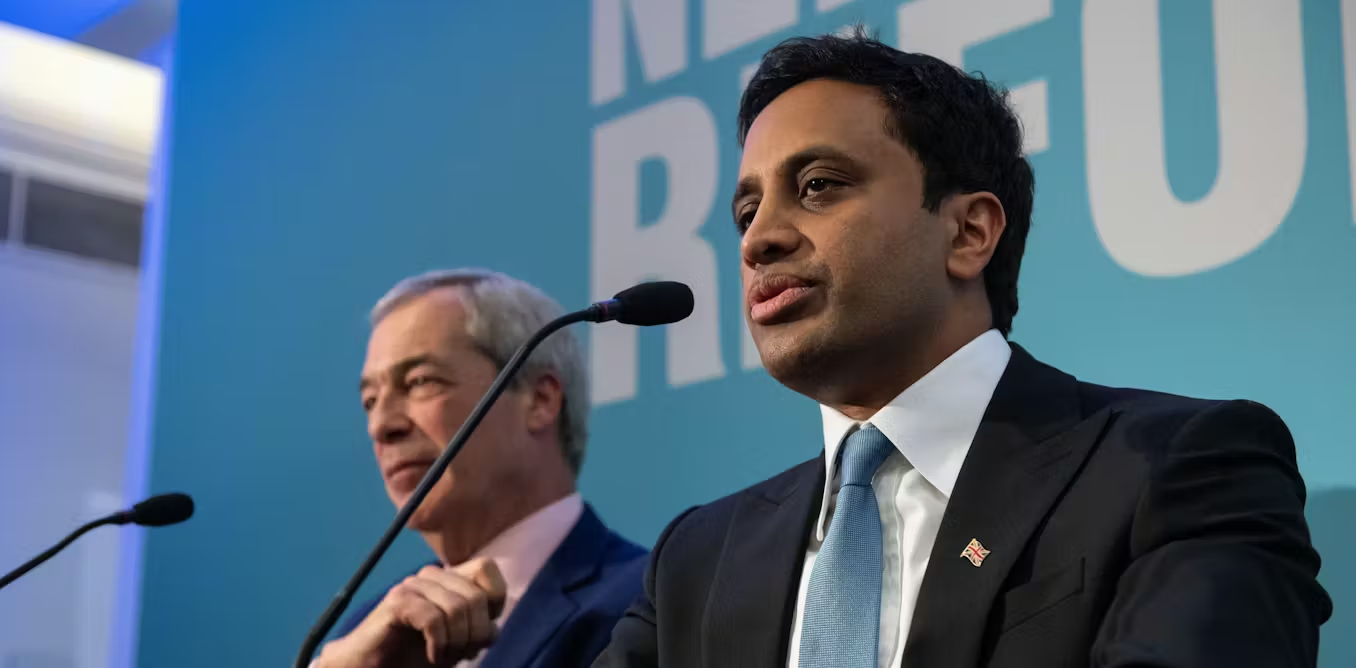
Zia Yusuf’s net worth has become one of the most searched queries in UK political media as the Scottish-born, Sri Lankan-heritage businessman from Bellshill, Lanarkshire transformed himself from Goldman Sachs executive director to one of the most pivotal and polarising personalities in Nigel Farage’s Reform UK movement.
Born in October 1986, Muhammad Ziauddin Yusuf — known universally as Zia — came from a family whose story is, paradoxically, precisely the kind that Reform UK’s immigration critics would point to as an example of successful integration: his parents, both NHS workers, emigrated from Sri Lanka to the United Kingdom in the early 1980s, with his father working as a doctor and his mother as a nurse.
Zia Yusuf Net Worth is estimated at approximately £31 million as of 2025, the overwhelming majority of which derived from a single landmark transaction — the 2023 sale of his luxury concierge technology company Velocity Black to American financial services giant Capital One for a reported £233 million, a deal that transformed Yusuf overnight from a well-compensated tech entrepreneur into a genuinely wealthy man with the financial firepower to shape British politics.
Zia Yusuf Net Worth — How Velocity Black Created A Political Kingmaker
Yusuf attended Hampton School in south-west London on a fifty per cent scholarship, where he first connected with his future business partner Alex Macdonald, and went on to read International Relations at the London School of Economics, graduating in 2009.
He entered the world of high finance immediately, joining Merrill Lynch before moving to Goldman Sachs, where he specialised in European automotive and defence companies and rose to the position of executive director — a career path that generated the professional credibility and financial knowledge that would later underpin his entrepreneurial ambitions.
In 2014, Yusuf and Macdonald co-founded Velocity Black, a luxury concierge application designed to serve the demands of high-net-worth individuals seeking same-day access to private jet bookings, rare luxury goods, celebrity experiences and high-end travel logistics.
The company’s growth was extraordinary — recording 848 per cent year-over-year growth in 2018 and winning an Apple Best of 2015 commendation — and attracting venture capital backing before the transformative £233 million Capital One acquisition in 2023 delivered Yusuf his estimated £31 million personal windfall.
That fortune immediately placed him among the wealthier individuals associated with British political parties, dwarfing the estimated £3-7 million net worth attributed to Nigel Farage himself, and positioned Yusuf as both a major donor and a strategically significant backer whose financial commitment to Reform UK carried real weight.
He donated at least £200,000 to Reform UK during the 2024 general election campaign — the largest single contribution received by the party during that period — and is believed to have served as a fifty per cent financial guarantor of Reform 2025 Ltd alongside Farage, representing a level of personal financial exposure that went well beyond casual political patronage.
Zia Yusuf Net Worth And His Turbulent Year At Reform UK’s Helm
The political journey of Zia Yusuf since his £31 million Velocity Black payday has been as dramatic as any chapter of his business career, with a rapid ascent to the chairmanship of Reform UK followed by resignation, reversal and reinvention at a pace that left even seasoned political observers struggling to keep up.
He was appointed Reform UK Chairman on July 11, 2024, succeeding Richard Tice, and immediately set about what he described as the professionalisation of the party — expanding its national branch network to over 400 locations, quadrupling membership to approximately 235,000 and driving the party’s poll ratings from 14 per cent to a sustained position of around 30 per cent.
The most turbulent episode of his political career arrived in June 2025 when he publicly described Reform MP Sarah Pochin’s call for a burqa ban as “dumb” policy — a characterisation that triggered a dramatic social media resignation post in which Yusuf declared he no longer believed working to elect a Reform government was a good use of his time.
Forty-eight hours later, following conversations with Farage, he reversed course entirely — acknowledging the decision had been hasty and returning to the party in a senior executive capacity that included responsibility for policy development, fundraising, media strategy and leadership of a Elon Musk-inspired Department of Government Efficiency initiative.
By September 2025 he was confirmed as Head of Policy, and by early 2026 he held the position of Reform UK Spokesperson for Home Affairs, though his relationship with the party and its most prominent figures remained characterised by the kind of internal tension that has marked Reform’s rapid expansion.
A June 2025 BBC investigation added further complexity, detailing allegations about Yusuf’s management conduct at Velocity Black — including claims about unpredictable behaviour, employee fear and allegations that he had approved inflated financial figures — claims that Yusuf strongly disputed.
Key Facts — Zia Yusuf
| Category | Detail |
|---|---|
| Full Name | Muhammad Ziauddin Yusuf |
| Born | October 1986, Bellshill, Lanarkshire, Scotland |
| Heritage | Sri Lankan (parents emigrated to UK, 1980s) |
| Education | Hampton School (50% scholarship); LSE, BSc International Relations (2009) |
| Early Career | Merrill Lynch; Goldman Sachs (Executive Director) |
| Company Founded | Velocity Black (2014, with Alex Macdonald) |
| Velocity Black Sale | £233 million to Capital One (2023) |
| Estimated Net Worth | £31 million (2025) |
| Reform UK Donation | £200,000+ (2024 general election) |
| Reform UK Chairman | July 2024 — June 2025 (resigned, then reversed) |
| Current Role | Reform UK Spokesperson, Home Affairs (2026) |
| Relationship Status | Single (as of 2025) |
Zia Yusuf remains a genuinely singular figure in British public life — a Muslim son of immigrants from Sri Lanka, educated at a prestigious private school and a Russell Group university, who made his £31 million fortune selling luxury services to the world’s wealthiest clients, and has deployed that wealth to drive the most significant political insurgency in British politics in a generation.
Whether the Velocity Black millions ultimately fund a Reform UK government, or represent a chapter in a still-evolving biography of a man who has not yet found his final political destination, remains one of the more fascinating open questions in the story of contemporary British politics.
About the Author
