
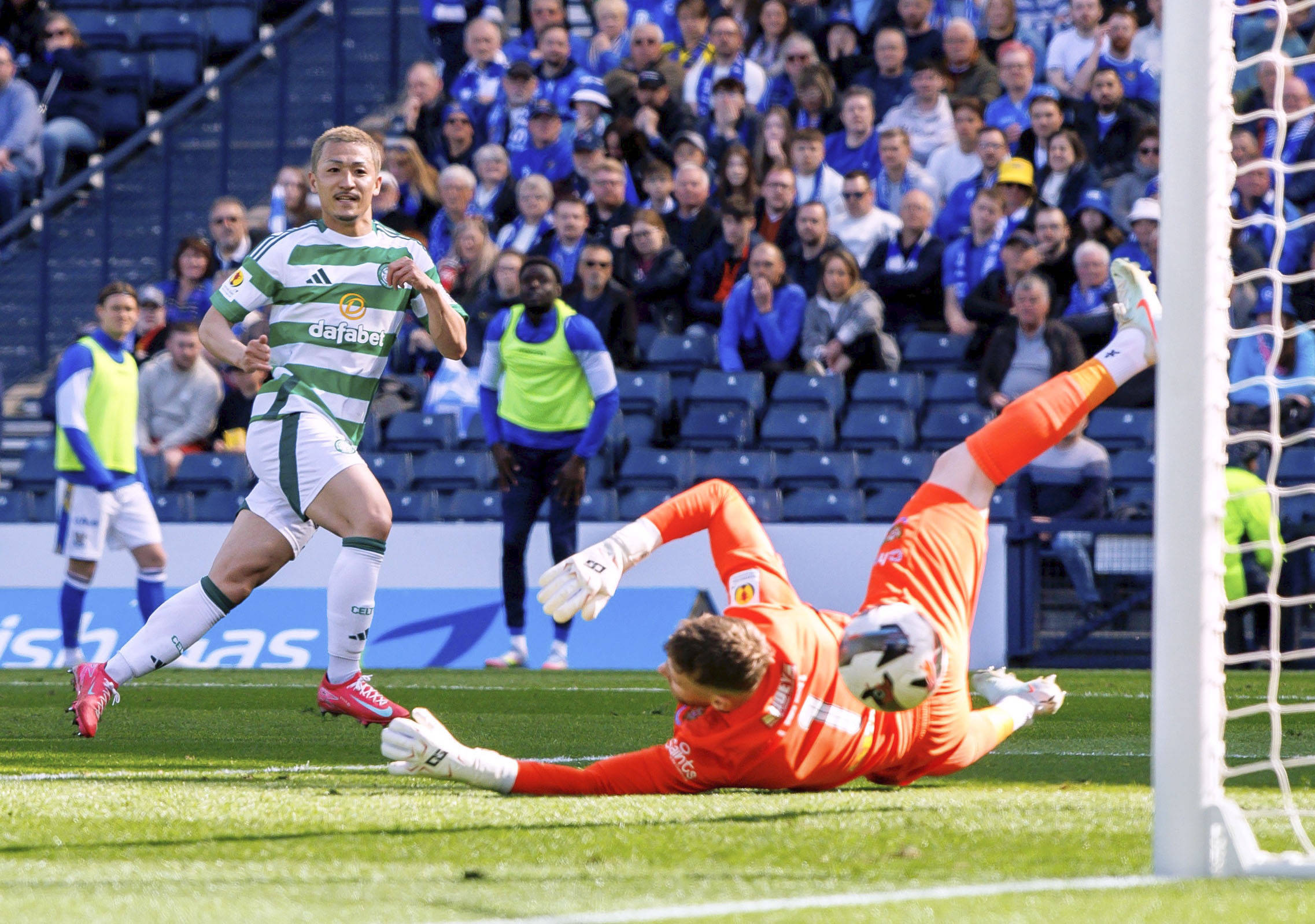
Football: Scottish Cup Celtic s Daizen Maeda L scores in the first half of a Scottish Cup semifinal football match against St. Johnstone in Glasgow, Scotland, on April 20, 2025. Imago Images
Celtic fans may remember Scott McDonald as one of the club’s most prolific strikers, but his departure from Parkhead was far more complicated than it appeared from the outside.
The Australian forward was just 26 years old and entering his peak years when his time at Celtic came to an abrupt and unexpected end in February 2010.
McDonald had scored 63 goals across two-and-a-half seasons under Gordon Strachan, establishing himself as the team’s most dangerous attacking weapon.
When Tony Mowbray took charge, however, the relationship between manager and striker never truly clicked, and McDonald sensed trouble was brewing long before the transfer deadline.
Speaking exclusively to Record Sport, McDonald said: “It culminated just in terms of the relationship with the lack of trust, probably within the manager and me at the time, and then everything culminating in Gordon taking the job at Middlesbrough.”
Celtic were chasing runaway league leaders Rangers in January 2010, and Mowbray responded by bringing in loan signings including Robbie Keane and Diomansy Kamara while shipping out experienced players.
Skipper Stephen McManus, Gary Caldwell, and Barry Robson all departed, and McDonald was eventually sold to Middlesbrough in a shock £3.5 million deal.
McDonald revealed the pivotal moment came during the New Year Old Firm fixture, when Mowbray left him on the bench against Rangers.
He said: “It was kind of put to me after that that Tony didn’t want me at the club from others externally working their ways, so that set everything alight from there and triggered a lot of things that happened.”
McDonald acknowledged the situation was messy, saying: “It was quite chaotic because the manager made it chaotic because of his ideas,” though he understood the board had little choice but to back their appointment.
This was a player who had struck 31 goals to fire Celtic to one of the most emotional title wins in the club’s history, coming just days after the passing of Tommy Burns.
Despite the difficult circumstances, McDonald holds no lasting bitterness, reflecting: “Every player has a sell-by date; some go before that date expires, some stay after it and rot.”
He added: “Should I have left? Could I have done things differently? Yeah, absolutely, in a bigger picture world, leaving Celtic is always a tough one for any player.”
The twist in the story came at Middlesbrough, where McDonald reunited with Strachan, only for his former Celtic boss to be sacked within the year and replaced by the very man McDonald had just escaped in Mowbray.
McDonald laughed off the extraordinary turn of events, saying simply: “It’s a good book someday, I’ll tell you that.”
He reflected honestly on both his own conduct and Mowbray’s management, admitting: “I know that I wasn’t the easiest to get on with at times as well and can easily look through a different lens to what I used to look at.”
Ultimately, McDonald found peace with how events unfolded, saying: “I think by the end we could shake hands and go, ‘Yeah, okay, you’re a good coach. Well, you’re a good player.’ And that was that.”
Unlike many of his Scottish contemporaries who struggled at Middlesbrough, McDonald thrived at the Riverside, finishing as top scorer in two of his three seasons before moving on to Millwall.
He said: “I loved it and have a real great affinity with that club, a real soft part of my heart in there because my two kids were born there as well.”
About the Author
